Replacing the FT-736R Power Supply
On Thu, Jan 4, 2024 at 12:35 PM, kf4hr3@… wrote:
Rob I’m getting ready to replace the power supply in my FT-736R. I would appreciate any photos you can post.
Thanks,
Butch, KF4HR
I have changed the topic, so it will become a separate and hopefully more descriptive thread.
Hopefully the pictures will post correctly; there’s a confirmed bug in the Groups.io software that makes just one pic appear at times. I’ll try and if need be post again at a later date after I hear the bug has been fixed.
To start at the beginning, I’ve replaced the original FT-736R power supply with a ECM100US12 from XP Power, which can be had used for a decent price from eBay. These are medical-grade power supplies with very good isolation between input and output, low noise, large input AC Voltage range and frequency, and very high reliability. You can pull up the spec sheet from the manufacturer’s site. Another likely advantage is that it should be more efficient vs. the original PSU (I don’t know what the efficiency is of the original, but it runs quite hot!), this new power supply stays cool with normal use.
This is the new PSU in its natural habitat:
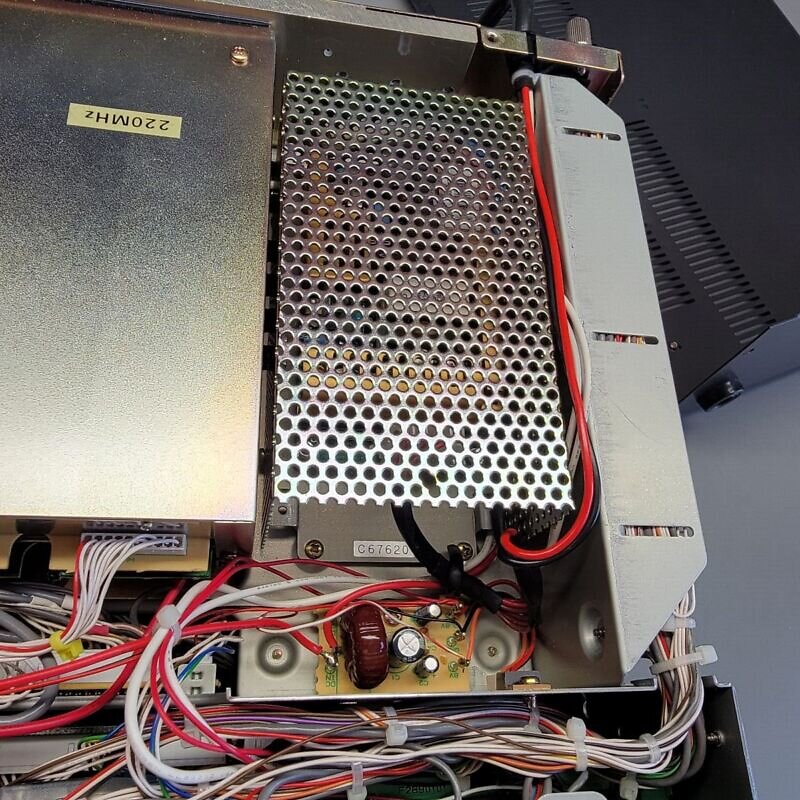
Here is a pic after removing the ‘tray’ from the rig, by taking off the two screw holding it in place, the same screws are used by the original power supply:
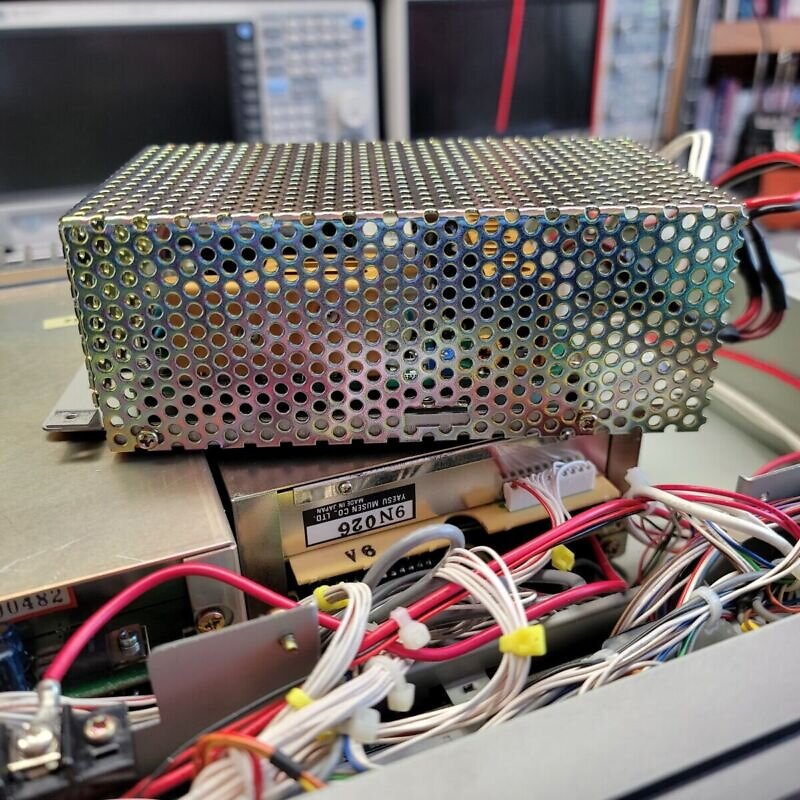
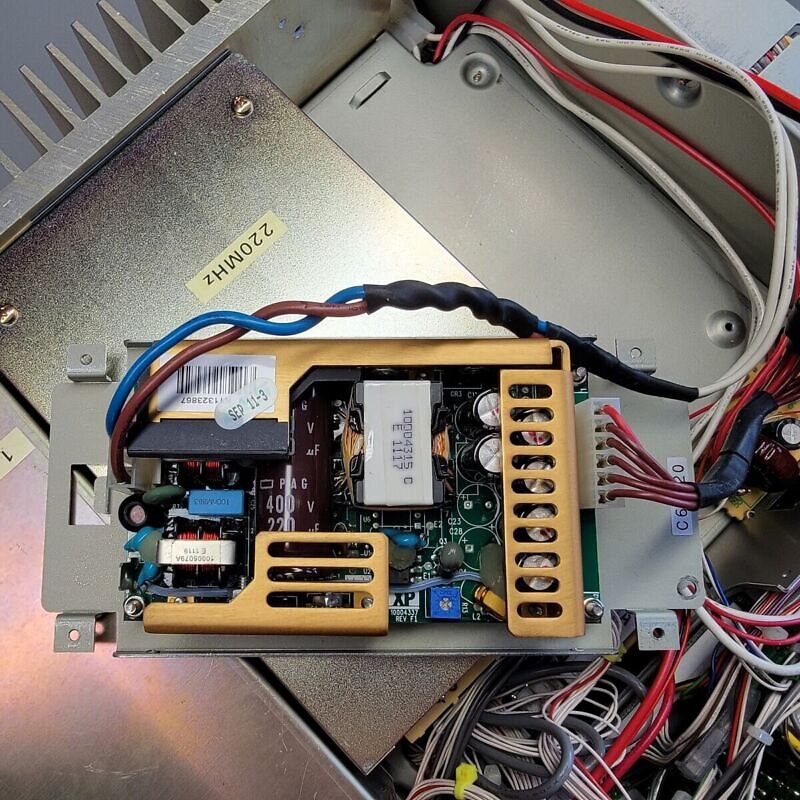
What that last picture shows is that I simply spliced into the existing wiring by soldering the leads from the new PSU connectors (mine came with connectors and wires attached to them) and using shrink tubing to cover each splice and then more (larger) shrink tubing to cover the wire bundles. I can unhook the new PSU if needed by taking the connectors off. Note that the old PSU was hard-wired, in fact the wire connections to the PCB on the old PSU are covered with epoxy or a similar glue.
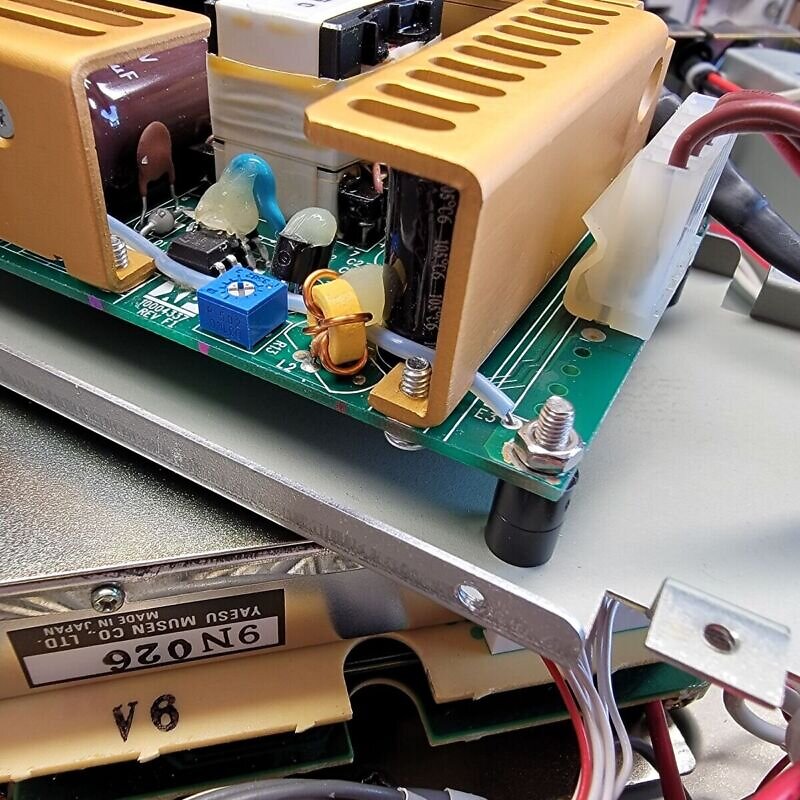
The output Voltage is nominally 12.0 Volt, but can be dialed up with the small blue potentiometer in the previous pic. This is the maximum I can get out of my new PSU:
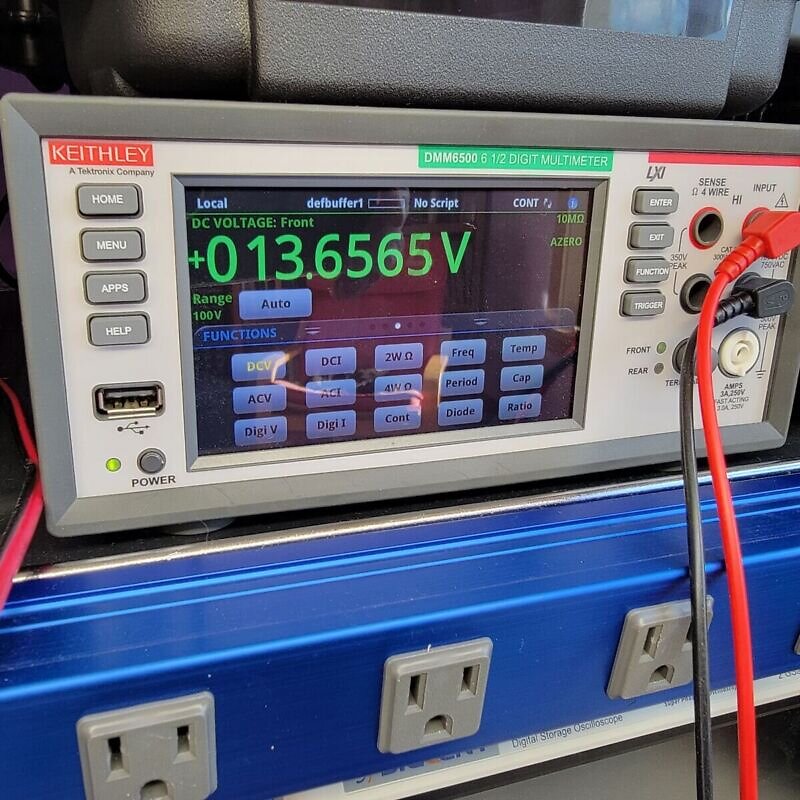
There is one potential issue: With the new power supply, after switching the FT-736 off and back on again quickly you will notice the PSU does NOT switch itself on! It took me some time to find out why, and some tracing of the components on the PSU (and looking at the datasheet for the IC used on this PSU). This is a safety feature; when the PSU senses output Voltage when there should be none, ie. after is has just been switched on, it will not enable itself and hence no output Voltage. I fixed that by adding two 4.7 kOhm resistors in parallel on the small filter PCB to more quickly bleed down the various capacitors that hold the Voltage up after the rig is switched off:
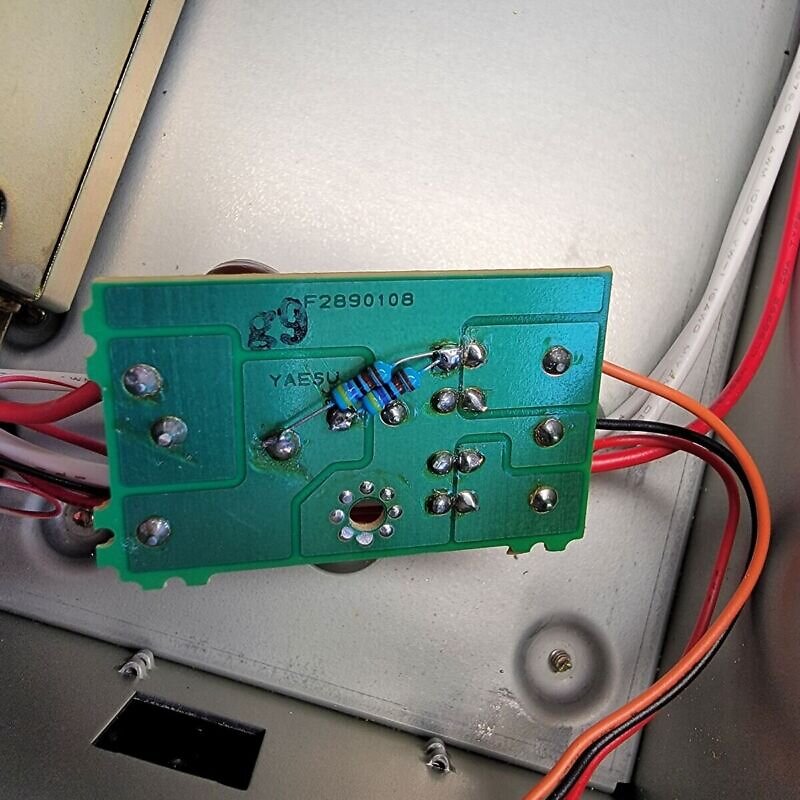
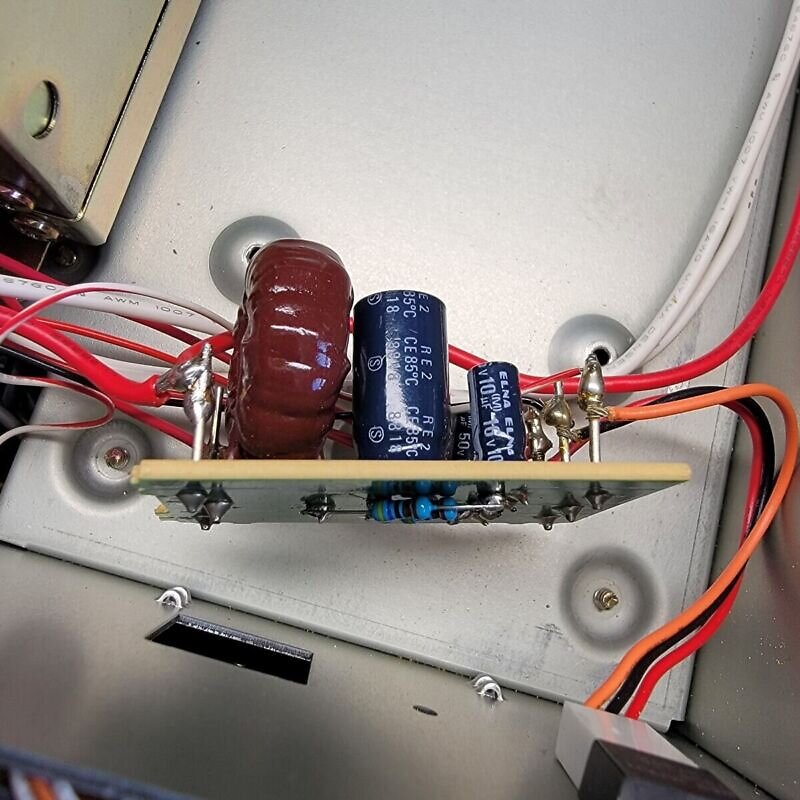
That solves it such that unless you are really quick in switching off and back on again there is no longer any problem. The new PSU will reliably switch on every time now. I still have the old PSU, and it works fine and is in good shape! No sign of any type of heat-damage. In case anyone is interested it is for sale! By the looks of it the main caps have already been replaced at least once by the previous owner. Contact me if you are interested (my E-mail is in my profile, it is public).
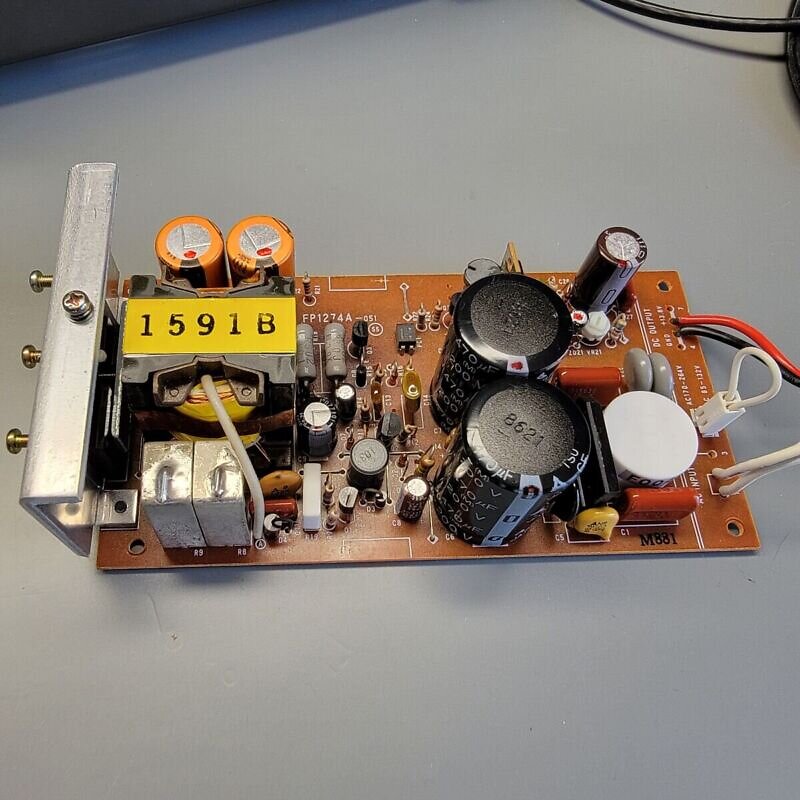
That is it!
I’m happy with the replacement, it is easy and minimally invasive. The new PSU works like a charm.
Hope this helps others that are contemplating the same improvement…
Some mentioned that the 120 Volt AC neutral is switched by the front switch (which is true, and it also switches the 13.8V positive at the same time). Personally I do not see any problem or safety issue with that (FYI, I’m and electrical engineer by trade so I’m not ‘just’ saying this lightly). The FT-736R is meant to be used with a 3-prong grid-connection, one of them being ground, and this WILL properly ground the metal housing. The only added risk is when working on the rig while it is plugged in; one should realize that the AC wiring in there can/will be under Voltage, but that is no different from working on any other AC appliance. Always assume the AC wiring is hot when plugged in! It is very safe otherwise. Changing the switch so the hot instead of neutral gets disconnected does not add any real safety (you may feel safer, but this is mostly imagination, not reality). FYI, the hot wire runs from the back AC connector to the switch and from there to the PSU, that’s it. It does not go anywhere else. If the PSU were to somehow break (very very very unlikely since the transformer on there is rated for multiple kV of isolation!), of if the hot wire frayed and contacted the housing, or if the switch broke and contacted ground the worst case would be to short hot to ground and trip the breaker.
My 2 cents…
Cheers,
-Rob-